Monthly Archives: March 2010

Living Theology #16 – Prayer

by Garrett Glende

It took me a while to figure out how to start writing this post. My usual format, if you haven’t noticed, is to refer back to the previous week’s article and give some sort of linking phrase to tie it all together. I felt like being a tad more creative tonight, but nothing really came to mind immediately. Then it hit me – maybe I should pray! I know what you’re thinking, “God obviously doesn’t answer prayer cuz that sure ain’t creative.” Maybe so, but at least it’s something. Plus it goes to show how often I fail to seek God’s help in my own life and I have a feeling many of you can relate as well.

In chapter eighteen of Grudem’s Systematic Theology, he defines prayer and fleshes out some of the basic concepts of the practice. He writes that prayer is “personal communication with God” and includes “prayers of request for ourselves or for others, confession of sin, adoration, praise and thanksgiving, and also God communicating to us indications of his response.” The concept is simple: we converse with God. But there is much more to it than just that. We aren’t just hanging out talking with God over a cup of coffee. We are communing with the sovereign Lord of the universe. He is a righteous and holy God, so we must not approach Him flippantly. He demands respect and reverence for no other reason but that He alone is God and we are not.

But what does prayer actually do? Does God hear our prayers? And what is its purpose? Personally, I often find myself wondering if God really does hear my prayers. It’s easy to think that my performance determines the generosity of God in responding to my prayers, but this is not a biblical perspective. Prayer does change the way God acts, as we see in the life of Moses when he prayed that God would not bring His judgment against the people and God “relented from the disaster that he had spoken of bringing on his people” (Ex 32:11-14). Grudem writes of James 4:2 (“you do not have, because you do not ask”) that “failure to ask deprives us of what God would otherwise have given us.” Surely God does hear our prayers, for He is omnipresent and omniscient, seeing and knowing our every thought. But this does not mean that all prayers are answered in the way we would like. We must seek God’s will in prayer, as a means of laying aside our own desires and trusting that God’s plan is perfect. Many times God’s will may be obvious if it is illustrated in Scripture, but there are other circumstances that the Bible is silent about. We must do our best to pray in accordance with the things that God has revealed to us, trusting them to be true and relying on God to give us wisdom about things that are not present in His word. In this way, the purpose of prayer is to increase our dependence on God and to develop an attitude of humility. The proud person does not often pray because he believes that He does not need to go to God for daily sustenance. Not only is a humble heart cultivated, but we can also express our thankfulness to God through prayer, giving Him the praise that He deserves. These elements, along with the confession of sin, are a basic outline of what we do when we pray and are explained by the familiar model ACTS (adoration, confession, thanksgiving, supplication). In prayer, we come before God and praise Him for who He is, confess our sins, express our gratitude, and ask for His will to be done in our lives.

The application here seems obvious. We need to pray. If we think we pray enough, we should pray more. JC Ryle, in his pamphlet titled “A Call to Prayer,” challenges the prayerless man with the following thoughts: “I warn you that you are in a position of fearful danger. If you die in your present state, you are a lost soul. You will only rise again to be eternally miserable. I warn you that of all professing Christians you are most utterly without excuse. There is not a single good reason that you can show for living without prayer.” So I would just want to echo the same question that Ryle asks: Do you pray? It should be as natural for a Christian to pray as it is for a husband to talk with his wife or for a son to speak with a father, but so often professing Christians fail in this area. If someone claims to have an intimate relationship with another person, yet never speaks with them, does this relationship truly exist? I would venture to say that it doesn’t. So how can a person claim to know God, yet rarely come before Him in prayer? It may be that there really isn’t a true relationship at all. These are somber words, but I fear it to be the case for many.

We must seek to understand the riches and blessings that God provides us through prayer. It is through prayer that we are empowered by the Holy Spirit to be useful for God’s kingdom purposes. All effective Christian ministry is fueled by an intense devotion to seeking God’s will in communion with Him. It is my own prayer that we would all humble ourselves, recognizing that we need to pray without ceasing, fully aware of our own insufficiencies, and trusting in Christ to provide all that we need.

DTR3

by Pastor John Kim

As we have been addressing the issue of dating relationships yet again for the third time in LBC history, I would like to share a few thoughts that I hope will be both encouraging and challenging to those who would be single and wrestling with the various aspects of dating as well as those older married folks who could hopefully fulfill the mentoring and discipling roles that would provide the kind of support that those who are going through what is often a stressful, even torturous period of life that is filled with uncertainties and hardships that are forgotten once married.

There are three significant foundational points that I have addressed in the first two meetings that have taken place. I have shared other things as well but these are three that I would like to highlight.

1. The Glory of God in Dating

Romans 11:36
For from him and through him and to him are all things. To him be glory forever. Amen.

The glory of God must be the chief end in the life of the believer and so it stands that the chief end of dating should be the glory of God as well. The fundamental problem that I think plagues many Christians in the issue of dating is that God’s glory is relegated to the sidelines and my own glory is put at the forefront. We are more concerned about ourselves, about having our desires fulfilled, our expectations met or exceeded, and the pursuit of my happiness is still considered an inalienable right that supersedes God’s glory. For the Christian that desires to fulfill 1 Corinthians 10:31, that in whatever we do, even in our eating and drinking, and yes, even in our dating, the glory of God must remain front and center in every aspect.

I think that the whole dynamic of dating exposes many Christian men and women in the superficiality of their commitment to seeing God glorified. While it is very understandable that a lot is at stake, potential marriage being the greatest possibility, it would seem to be clear that there should be nothing that escapes this mandate. But why is this most basic and fundamental tenet set aside?

Romans 11:36 helps provide some additional thoughts that I hope will be helpful for all to consider. When we recognize that all things are from God, that all things are only possible through God, and that all things are to ultimately point to God, it leaves nothing to ourselves in terms of receiving glory. We are to acknowledge that God is the source of all things, that God provides the enablement and empowerment for all things, and that He is the ultimate goal in all that we do. Every part of the process from beginning to end in our lives is accounted for in this verse.

Our problem is that we struggle with handing over the reins for the whole deal. We want a say in every aspect, even to the point where we would make demands of God that are more self-serving rather than God-glorifying. We forget that it is by grace that we receive anything and so all that is from God is a gift, even the gift of singleness. We forget that it is by the divine enablement of the Holy Spirit through the counsel of the Scriptures that we are given the tools to live out our lives to His glory. We forget that the chief end truly is God’s glory and we set ourselves up instead to be the chief end in receiving the attention that we so desperately desire. So it is no surprise that we fall short of the glory of God (Romans 3:23) and are caught in the throes of sinful attitudes, sinful thoughts, sinful motivations, and ultimately sinful behavior that really mimics the world through its conformity rather than showing a life transformed by the cross.

That leads the to second foundational point:

2. Gospel-Centered Dating

The cross of Christ should be at the heart and soul of how we live the Christian life. The cross not only justifies us but the cross also should sanctify us in that we live in light of the finished work of Christ and the righteousness that was secured and imputed to us. To live in light of Christ and Him crucified is not something that happens passively. It is a deliberate choice that then sets the reference point for how we are to engage in every arena of life, including dating.

Do your dating relationships celebrate the cross of Christ? It would be tough to say so if you are indulging in sexual immorality. Does knowing Christ and the fact that His grace has saved you from your condemned state before God make a difference then how you are to uphold separation from an unbelieving partner? Does the forgiveness that comes through the redemption found in our Savior provide the basis for how you handle conflicts regarding relationships? It is strange that for so many Christian, the cross of Christ seems to become nothing more than jewelry instead of the defining point for how we live from day to day.

I would like to challenge each individual, whether you are dating or not, whether the cross is truly central to your life on a daily basis. Or have you setup another idol that would affect your outlook toward life, namely even the concept of dating, or the absence of it? If you live in light of Christ’s death and resurrection and consider it of first importance as 1 Corinthians 15 describes, that it will provide a whole different outlook toward life and I believe it will definitely affect your outlook toward dating.

3. The Richly Indwelling Word of God

Colossians 3:16-17
Let the word of Christ dwell in you richly, teaching and admonishing one another in all wisdom, singing psalms and hymns and spiritual songs, with thankfulness in your hearts to God. And whatever you do, in word or deed, do everything in the name of the Lord Jesus, giving thanks to God the Father through him.

God’s Word needs to be more than just a visiting neighbor in our daily lives. The Scriptures need to take residence and permeate our entire being so that we would be equipped to do all things, every word and deed in the name of our Savior. Then we truly can give thanks because we will then be doing exactly what Romans 12:1-2 calls us to do, to present our bodies as living sacrifices, holy and acceptable to God. We show that we are not conformed to worldly philosophies and human wisdom but instead having been transformed by the renewing ministry of the Word of God, we will be able to discern what the will of God is, that which is good, acceptable, and perfect. This is crucial for all aspects of life but all the more crucial for dealing with the issue of dating.

Too many people claim that the Bible has nothing to directly say about dating but that is to reveal utter foolishness and ignorance. The Bible has everything to say about dating because it deals with the heart issues to our conduct that takes place in the dating realm. That’s why to hear, read, study, memorize, and meditate on God’s Word is a non-negotiable practice if we are to not only glorify God in our lives, but even in how we are going to teach and admonish one another in the issue of dating.

There are so many instances when I have heard of the kind of counsel that people give in regards to dating and it really is nothing more than earthly wisdom. There is nothing about the glory of God being at stake. It reflects nothing of the gospel of Christ and in the end it reveals a lack of Biblical foundation and substance. This is tragic, that the people of God would forsake the Word of God in the time that it is needed most. The wild and crazy ride of the dating rollercoaster can only be tamed by the sure and sufficient Word of God that will provide the solid foundation as well as even the practical wisdom that is needed. So immerse yourself in the Word. Failure to do so will lead to failures that you will regret. But to meditate on the law of the Lord will lead you to be like that tree fimrly planted by streams of water (Psalm 1). You’ll never regret living according to God’s Word.

Well just a few thoughts for now. More to come on April 11 and 18 at 6pm at the church. We’ll be looking forward to looking at what men and women should be to become marriageable and we will also take a long hard look at the issue of purity. So come out, invite your friends, even your unbelieving friends, and let’s tackle this issue and trust that God will accomplish great things in your lives!

Church Plant Interviews – Pastor Patrick (part 1)

by Richard Shin

Pastor Patrick graciously allowed me to invite myself over to his place. As we sat in his living room, he talked very honestly about his thoughts on his ordination, the mutual love between him and the church, and his future role as Senior Pastor of Lighthouse Bible Church. The text does not do justice to the amount of personality he showed during the interview. I hope that, as you read it, you would imagine Pastor Patrick saying these things. And through it all, I really hope you will come to understand him more as he assumes a greater responsibility in the coming months. At the same time, I hope you also come to understand that we worship the much gracious and loving God who grants him that responsibility.

Can you tell us who you are, and what your role is?

My name is Patrick Cho. I am currently an Associate Pastor at Lighthouse Bible Church, but this summer when the San Jose church plant team leaves with Pastor John, I will be stepping in as Senior Pastor.

How do you feel? Are you scared?

People ask me this a lot. My response is almost always the same. I don’t think “scared” is the best word. I’m not scared because obviously I know God is in control. And actually given the situation, it actually breeds a lot more confidence. The church was planted ten years ago, and we’re still here. And just to have seen God’s faithfulness in the past ten years, it makes you wonder, “Is He just going to abandon us now? Did He bring us this far just to leave us?” No. It’s hard for me to accept that. As God has walked with us, we trust that He will continue to walk with us. I’m not saying it’s going to be easy; I’m sure it’s going to be challenging. I’m sure I don’t even know half of what I’ll experience, even in the near future. But I’m not scared. No. I think more than anything, I just recognize that I need to be dependent. And I think that’s one very important perspective.

What are some fears you have to trust God with?

Well, there are all sorts of unknowns. For instance, when the church plant leaves, what if the San Diego church dwindles down to like ten people? You can’t really get caught up with the what-ifs because all sorts of stuff could happen. A storm could come through, and a tree could fall on our church building. Or I die (chuckle). All sorts of different things could happen. Again, I just look at the pattern of ministry that we’ve had the past ten years. Even though there’s a good group of people leaving for San Jose, the majority of the church is still staying. And I think the spiritual atmosphere has been pretty consistent over the years. We’ve had a lot of members who just love the Lord and want to grow in His Word and want to serve and help. Personally, I think we have one of the most generous congregations in the world. Because of that, I don’t get too worried about all the crazy what-ifs. Like I said, I’m just confident that God has led us this far, and He will continue to lead us. Personally I’m a firm believer that God stands for those who stand for Him. Deciding to go plant the church in San Jose is not the “easier” road. We’re taking the more difficult road. Because of that, I think God will bless it.

Throughout the ordination process, and just your overall ministry at church, you and your family had to go through a lot, I’m sure. What has been a significant concern or challenge so far? And significant blessing, if different?

Over the past ten years, John and I have spent so much time together. It really has come to the point where I can finish his sentences. And we have a good sense of how we feel and what we’re going through and what’s bothering us; we have a good read for each other. I’ve just been so thankful for all the training I’ve received on the way. I think one of the things that Christine and I talked about is that once John leaves for the church plant, Angela’s going to be leaving too. That’s been something we’ve been wondering what it’ll be like. She does so much to help the ladies of the church. Christine and Ange, although they do spend a lot of time together, it’s nowhere near the time John and I spend together. And I think that will be challenging. For both of us, we’ll have big shoes to fill. One thing I’m thankful for is that it’s not our job to live up to them. Our job is to do our best with what God has given us and how God has gifted us. I’m not John Kim and Christine’s not Angela Kim. And hopefully we won’t be expected to be. I’m sure in some ways when John leaves, certain things will change. We’re different people with different styles and different focuses, different drives, different passions. It’s not going to be the “same as always”.

To answer that question, some things are going to change and people typically don’t like change. That’s why we’ve been warning the church to brace itself. It’s going to be a changing year. There’s going to be a lot of change coming this year. That’s what happens when thirty people up and leave with two-thirds of the pastoral staff. That’s just the way it’s going to be.

One blessing is, while I always knew ordination was kind of there, and I always knew at some point I would have to go through it, but I was hoping to go through life being able to avoid it. Maybe Jesus would come back or something. It’s kind of like graduating seminary. When I graduated seminary, I thought, “Wow, how did I just do that?” That’s crazy. What an accomplishment, not for myself, but to see God lead me through that. I remember feeling so much joy. He didn’t have to, you know? He didn’t need me. And to have graduated with a bit of success too is really reassuring for me. And the same thing with ordination; I told John, I don’t want to just pass. If I’m going to study for it, I’m going to do well. It actually puts a little bit more pressure on me. I don’t want to just get by. I want to put my best effort into it. When it was all over, I just remember thinking, “Wow, He did it again!” God helped me through it again. I mean… I really have no reason to doubt. I have no reason to think God’s going to just leave us. He’s just been so amazingly faithful and gracious to us. It’s been great.

What doctrine or particular passage from the Bible has been encouraging you the most in your endeavor to be ordained and eventually lead Lighthouse?

Sure, sure… Actually, this one’s kind of easy. I’ve always drawn the analogy of Moses and Joshua and John and myself. Not to say that we’re of that spiritual caliber, but the circumstances are very similar. Kind of like what I shared during the ordination service. Both are of significant change, a transition of leadership, tremendous responsibility. There are a lot of parallels between the two. And if you look at Joshua and his character, he had sometimes an imbalanced sense of loyalty for Moses, and sometimes I think just the fact that I’m young, that comes across too. I’ll speak before I should, and I’ll come to John’s defense, like “how dare anyone say anything bad about John?” kind of thing. I see a lot of that parallel just to see how Moses trained up Joshua and trusted him with leadership and all of that.

And a significant chapter is Joshua 1 where the Lord tells Joshua, (paraphrasing) “be strong and courageous as I have been with my servant Moses, so I’ll be with you.” John has been such a big source of comfort to me. John and I serve the same God who shows the same faithfulness, who provided for John all these years for all that he went through. The same God that carried Him through all of that is the same God who keeps me. And I told him that there will probably be times when I’m very tempted to call him and get all the answers from him. But there’s a side of me that wants to just trust and wait and see how God will teach me through particular circumstances too, in the same way that He taught John. And who knows? Maybe He will teach me some completely different lessons through very similar circumstances. But I’m excited to see what that will be. I’m glad to have a lifeline; I really am. I’m sure I’ll make use of it. It probably won’t be the case where I’m calling him every day asking, “What do I do now? What do I do now? What do I do now?” There’s a sense where I just need to trust in God who leads me, the same Spirit indwells us, and the same Christ saved us. It’s just amazing to think it really does help build a lot of confidence. That’s why I said, I’m not scared. Even though it is a formidable task, I’m not scared.

What is the most valuable lesson you’ve learned serving under Pastor John (whether it be through his actions or his speech)?

Yea… In a word, it’s “ministry.” I’ve said this often, and that’s that John has taught me everything I know about ministry. I mean, seminary taught me a lot of principles and theology, but John helped me bridge theology to life. And not only has he taught me that, he has shown me. Just having seen him go through the trials that he has gone through, just seeing him lead his family, just seeing how he’s committed to the church. There are days when he comes before I do, and he stays way later than anybody else. Just the self-sacrifice he puts into the ministry is a huge example for me. So often I would go to our pastoral staff meeting, and they would ask, “how has your week been?” and I would say, “Man, it was tough.” And then he’ll come over the top and I’ll think, “Man, I have no reason to complain. My life is easy in comparison.”

I’ve really appreciated John’s scope and lens, his listening ear. He still treats you like you’re the most important person. He just has this way… that is one huge lesson I’ve learned from him: how to relate to people. That is his strength; that is his forte. Relating to people, helping them, and challenging them to live according to Biblical standards, according to Biblical principles. For me, I love teaching the Word. While I do consider myself a people person, I just don’t have that wealth of experience that John has, counseling people and all of that. I’ve learned so much along the way.

There would be times I would sit through counseling sessions, and I’m thinking, “He’s going to tear this person apart!” And then he’s totally gracious. And there are other times I think he’s going to say one thing, and then he goes a completely different direction. I mean, he’s not perfect. But I would say as often as I’ve seen him, the direction he has steered counseling sessions have been the wise directions. Where I might react too quickly with anger, he has shown patience and forbearance. And where I might have shown too much leniency in certain cases, he has been direct. And I’ve been really thankful having seen that over the years. I don’t have all the discernment yet to be able to distinguish between the two [situations], but he has really taught me many of the signs to look for, just really helped me in terms of what passages to turn to… oh, there’s so much more…

What would you like to see LBCSD work on? What practical steps do you want us to take as a body?

It’s kind of the same as it has been: a commitment to the MVP and a commitment to the Peacemaker Pledge. I think so long as we’re committed to that, we’ll be okay. It has been that way since day one. If anything were to be a significant threat to the church, it’s going to be the members’ unwillingness to resolve things in a God-glorifying way.

I would like to see a greater commitment to that one-body principle. I would love to see at church on Sunday where no one feels left out, where no one feels like an outsider. And that’s something that everybody needs to work on. It means not gravitating towards people you’re comfortable with. It’s reaching out and (God-forbid!) talking to new visitors. Not leaving it for the New Visitor Team to do it. It’s something I’ve told the college group too, “You all are the New Visitor Team”. We actually have a team to help facilitate things, but the entire group is the NVT. And all of us need to be making an effort to continue to do that.

And I’m not saying that we don’t. Honestly, I’m really happy with the way things have gone the past ten years. We have a wonderful congregation. And the testimony of those who have come supports that. I’m not just trying to toot our horn or whatever, but people have come and said, “This is one of the most welcoming churches I’ve been to. This is the most loving church I’ve been to.” And that’s funny because we’re so often tagged with being so committed to truth that we don’t love. And I would really challenge anyone who has that opinion to come and visit, and spend a day with our members and tell me we don’t love. Our members are loving. But I think it could be an excel-still-more kind of thing. It’s one of those things that you could always do more. And in ten years from now, if we were still doing that, how awesome would that be.

A thing I would like to see more of at our church is a deliberate outreach mentality. Again, I don’t think we don’t have that. But again, it’s one of those excel-still-more kinds of things where we could do better.

But, you know, it’s all ideal. It would be great to send out a missions team and every member from the greatest to the least of them are on board. And when we come back, and we do our missions report night, every member is there because they felt like they were part of the team. They weren’t just giving a donation, but they were actually part of the sending team, and they’re passionate about what they’re supporting. I’m not sure we’re quite there yet. I think that’s the case for some people, but I’m not sure it’s the case from the greatest to the least of them.

And lastly, we still have a number of members who aren’t doing much. There are members, but they’re kind of the “invisible” members. They’re not serving in any ministry; they’re not serving in any capacity. And I would like to help challenge those members be part of the body, help us function together, help us grow together, as it says in Ephesians 2 to “grow into the holy temple of the Lord.” That would be good. There aren’t a lot of them though. And that’s the thing I’ve been really thankful for, the members at our church. I have only reason to be thankful. I think many pastors would be very envious of our church in San Diego. Not to say we have the perfect church, but we have a lot of reasons to be thankful.

(to be concluded next week with part 2)

Weekly Links (3/26/2010)

by Stephen Rodgers

So I’m going to try something slightly different this week. I’m going to frontload maybe half a dozen articles and videos at the top of this post, and then highlight a couple of series that you might have missed or should keep an eye on below that. Enjoy!

So that brings us to the series part of the post. First up, the guys over at TeamPyro did an apologetic series called “Redneck Atheism” in which they dealt with a number of popular anti-theist memes. I would recommend this series as a survey of Biblical apologetics and confronting the culture of today. Each article deals with one or more popular objections to Christianity, which I’ve included in parenthesis. Yes, I can see for #5 that it’s quite redundant (WEB):

  1. “Unquestioning Christians” and Atheistic Bluster (Introduction)
  2. Redneck Atheism (Monotheism and Evolution)
  3. Is Christianity Really Polytheism (Polytheism)
  4. Whence “Redneck” Atheism (How Did The Series Get Its Name)
  5. Prayer (Prayer)
  6. Science vs. Enthusiasm (Science)
  7. Biblical Ignorance (Uninformed Christians)
  8. The Hypocrisy of Secular Humanism (Moral Contradiction)
  9. I Doubt It (Agnosticism/Conclusion)

Over at the Resurgence, they’ve got two interesting series going on. The first is a series of interview with Michael Horton, Professor of Systematic Theology and Apologetics at Westminster Seminary California (VIDEO):

  1. What Is Moralistic Therapeutic Deism?
  2. Why You Can’t “Be” the Gospel
  3. What We Should Learn From the Mainline Denominations
  4. Is the New Perspective on Paul Dangerous?

The second series just got underway, and deals with famous heretics of church history (WEB):

  1. Pelagius
  2. Arius

(Actually, on a side note, since we’re talking about TeamPyro and heresy, Phil Johnson once told me (and a lot of other people, since he preached a couple sermons on the topic), that almost all false doctrines fall into one of five heretical archetypes: legalism, gnosticism, Pelagianism, Arianism, or Socinianism. You can download his sermon series on that topic for free.) (MP3)

Alright, that’s plenty for this week. See you Sunday!

Pro Rege

Refreshments Ministry

by Hwa Park

Hello, My name is Hwa and along with my wife Suzie and about 10 other faithful servants we make up the refreshments ministry. The primary purpose of this ministry is to glorify God by feeding our Church
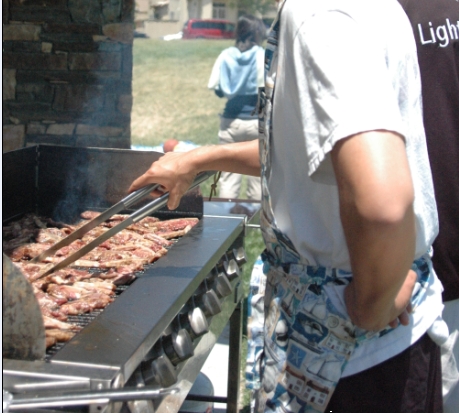
family during various Church events (1 Corinthians 10:31). At our Church we love to eat and more specifically we love to eat a lot of meat and I have the pleasure of filling our bellies with yummy meat. We believe that God created everything that is on the earth and that all food is clean and suitable for consumption. With an exception that if eating or drinking causes a brother to sin we will abstain from it
(1 Corinthians 8:13).

Over the past 11 years the role of refreshments ministry has evolved from one person feeding about 30 people to now over 10 workers consistently feeding as many as 300 people. The Refreshments Ministry provides Sunday morning delights and refreshments for various other functions such as Fun in the Sun (FITS), Anniversary Services, Resurrection Sunday breakfast, Thanksgiving, Christmas, Mission bowl, and Members Meeting Dinners. Over the years I estimate we served about 11 thousand meals that include about…

  1. 700 lbs of Turkey
  2. 500 lbs of Ham
  3. 400 lbs of hot links
  4. 500 lbs of hot dogs
  5. 880 lbs of hamburgers
  6. 3,000 sandwiches
  7. 500 lbs of fried chicken
  8. 1,000 pizzas
  9. 15,000 bottles of water, sodas and juice boxes
  10. …and 1 lb veggie burger (back in 01′)

We can always use faithful servants that enjoy serving others through food. If you are a member please contact Suzie at suzie4jc@yahoo.com. How much food to prepare is always a challenge as we never really know how many people will show up to various Church functions. Portioning and menu planning can also be difficult as men will often consume more food then the ladies. Please pray that our team will serve others with a humble heart that seeks to glorify God.

Church BBQ Grill

Editor’s Note #2: March 2010

by Stephen Rodgers

The RSS button in the sidebar has been fixed. So if the only thing preventing you from enjoying RSS updates was my inept code, that obstacle has been removed.

If you prefer to enjoy the site simply by visiting it everyday, then nothing has changed for you.

Also, since we are once again benefiting from the DTR3 series at church, I wanted to bring your attention to some of the DTR-related content we have here on the Beacon:

Just letting you know.

Pro Rege

Book Review: Thoughts For Young Men

Book by J.C. Ryle

Book Review by Cesar Vigil-Ruiz

When you have thoughts reserved for young men that stem from personal experience, the basic qualification needed is that the person who has these thoughts is no longer young and is a man. It’s assumed these are thoughts that young men would benefit spending some time to consider. Well, from reading this short book, J.C. Ryle is more than qualified, and young men would be foolish not to heed this man’s advice.

If you don’t know anything about Bishop Ryle, you would think this book was written very recently, since many in our day are averse to spending time with young men, and would appreciate some kind of word that would jolt them into sober-mindedness. Surprisingly, for those unaware, Ryle died in 1900, and wrote this at a very late age (71 years old). How often would you come across an older man at that age who would gladly spend time with you and impart to you his wisdom that he’s gleaned over the years—especially a godly man? How many of us know men that age who are still following hard after Christ? It’s books like these that remind me that I am in need of learning—not to be proud of how much I know now, but grateful that I have a resource from which to observe this kind of wisdom. That’s what every book (including this one) has brought me to realize. I am not perfect in this life (nor will be), so I must grow in the knowledge of our Lord and Savior Christ, and, in His wisdom and sovereign will, has given various men (and women) in the faith to have wisdom to share with the body of Christ.

This book is broken up into four parts that J.C. Ryle believes is crucial for the life of a young man:

  1. The Reasons for Exhorting Young Men
  2. The Dangers of Young Men
  3. The General Counsels to Young Men
  4. Special Rules for Young Men

Titus 2:6 has formed the basis for why Ryle thought it necessary for him to write this book: “Young men likewise exhort to be sober minded.” Following the Apostle Paul’s advice, he plows through within each of these four sections, and speaks frankly, as well as compassionately, to the youth of his day (and ours) about the reality of life in a fallen world. Reading this book, I couldn’t help but be reminded of my need for older men to guide me in my walk with Christ, and to be slow to speak and quick to hear. Ryle knew the many temptations of a young man, since he was one. He remembers vividly the mistakes he made and saw that it as inherent in a young man to welcome many problems into their own life without giving an ear to one who has already gone before them.

If you have read anything written by Bishop Ryle, you know he asks very uncomfortable questions, not unnecessary ones. It’s pointed straight at the heart of every young man, who very much knows the answer to many of his questions, and yet could also be self-deceived into the answers they give. Easily, the entire book could be quoted, since there is much to learn from each sentence that he writes. Here are a few:

I tremble to observe how few young men are led by the Spirit—how few are in that narrow way which leads to life—how few are setting their affections upon things above—how few are taking up the cross and following Christ. (6)

Who in their families give them most pain and trouble?…Who are the class which requires the most incessant watching and looking after?…“The Young Men.” (7, italics his)

Two things are said to be very rare sights in the world—one is a young man humble, and the other is an old man content. (19)

Contempt of holy things is the high road to infidelity. Once let a man begin to make a jest and joke of any part of Christianity, and I am never surprised to hear that he has turned out a downright believer. (28)

[S]eek to become acquainted with our Lord Jesus Christ. This is, indeed, the principal thing in religion. This is the cornerstone of Christianity. Till you know this, my warnings and advice will be useless, and your endeavours, whatever they may be, will be in vain. (34)

And that is only half the book! This book is like listening to a father speak to his son about what is most important. However, in this case, it’s a worshipper of Christ who seeks to bring other people into true worship of the risen Savior, all for the love of the little ones (Mark 10:14). If you are a young man, read this book. If you are a man, read this book. If you have doubts as to how Christianity relates to your teenage life, read this book. If you are one who desires wisdom from above, read this book. Your life will never be the same, if you put into practice the appeals of this godly man.

Live Free or Die

by Elder Peter Lim

Some fun state mottos include “It Grows As It Goes” (New Mexico), “By and By” (Washington), “She Flies With Her Own Wings” (Oregon), and “Manly Deeds, Womanly Words” (Maryland). But perhaps the most memorable motto is New Hampshire’s “Live Free or Die”. This motto means serious business. They desire that the government keep their hands off as much as possible. They have no state tax. On one hand it speaks of a most noble desire to live with freedom above all else, even death. On the other hand it communicates a militant agenda, no doubt a reference to the values that led to the American Revolution. For Christians, our motto is similar to New Hampshire’s with some differences. It is based on Philippians 1:21 – For to me, to live is Christ and to die is gain. Paul had a difficult time deciding which option was better for him. (Phil. 1:22-24) To be able to live his life, he knew that he would fill it with profitable activities (see my last article “Minesweeper, Solitaire, Sudoku”) and so his life would revolve around Christ and His gospel. To die would mean an immediate trip home to be with Jesus forever. This was a win-win situation.

Too often, many Christians don’t think the way Paul thought. We would rather live our normal lives doing all the usual things that other normal non-Christians do. We may even try to Christianify different aspects of our life in order to justify our lifestyle. (yes, I made up that word) For example, we go watch a movie or play basketball and call it fellowship. We idolize celebrities and entertain ourselves with worldly thoughts, ideas and TV shows and separate these areas of our lives apart from our faith. Most of us work for a living in order to take care of our families. We strive to get promotions at work in order to earn a larger paycheck and to move up the corporate ladder. Then we buy nicer cars and live in big houses in order to make life convenient since we are working so hard to sustain this lifestyle. Note that none of these things are necessarily sinful all by themselves. However, the question is not whether something is sin or not. The question is, are we living for the sake of the gospel or not. A non-Christian family can do exactly the same thing as the example above. Then what is the difference between a Christian and a non-Christian? The difference must be Christ. Imagine someone going through High School with straight As, getting accepted to Harvard, starting a company that grows into the Fortune 500, retiring at age 40 with $500 million in assets, but is not living for Christ (whether this person claims to be a Christian or not), this is the epitome of a wasted life. If we don’t live for Christ, it’s not worth living. I am proposing that as Christians, we adopt our own motto based on Phil. 1:21: “Live For Christ or Die.”

Church Plant Interviews – Pastor John (part 2)

by Richard Shin

What is the greatest legacy you would like to leave behind as you depart from San Diego?

I hope that people would have known that I genuinely loved God and loved people; I know I don’t do it perfectly. That I’ve tried to be a sincere gentleman in fulfilling my role as a pastor. And I hope that people would have been challenged to look beyond the status quo. That they be willing to trust God, and that they be willing to have God be front and center of their lives, to the point where they submit family life to that, and church life and school and job, everything. I think Matthew 16:24 is probably a verse that has impressed upon my heart in junior high. And it says if anyone is to come after me, deny himself, pick up his cross, and follow after me. It’s just very clear, that my life now is no longer for myself, but to follow Christ, and that everything in life would revolve around that.

I hope people know that I enjoyed life too. I liked to have fun, but not fun for fun’s sake, but really to celebrate people and their lives. I hope people would know I have genuinely cared for people. I’ve been willing to be part of people’s lives in whatever ways God would have me.

I think I’ve made more than my share of mistakes. I hope people would be forgiving toward that, as well as all the long, long sermons. That’s one thing people will probably remember me for, more than anything. I hope it’s not just the length of the sermon, but it’s the heart and principle of the sermon that would be left behind.

What will you miss most about LBCSD? And San Diego in general?

Well, the people for sure. I really love our church family. We’ve developed such precious friendships with many people. Those are things you just can’t trade. I will miss those especially who have ministered to our family. I know our kids will miss all the other kids, especially all their cousins. Yeah… definitely the people. There are other things I can live without, even things like Mexican food and stuff like that. But the people really… having seen the church grow, and coming into this office, and having all the books there, those are all things I’m really thankful for, but more than anything, it’s the people that I would miss the most. I’m already sad thinking that I’ll miss out on seeing the kids growing up. I love watching all the kids. I love playing with them and making faces at them. I’m kind of sad because none of them will probably remember me, but I’m sure I’ll have the chance to visit time to time, and I’m sure people will visit. But it won’t be the same. That’s something I learned when you move to a different place. Things just aren’t the same. I’ll definitely miss a lot of the people. But I hope to carry on the friendships to the future too.

Let’s say you stepped into the building of LBCSD ten years from now, what would you like to see?

Oh, boy… I would like to see everyone here ten years older. But ten years even more mature in their faith. I would like to see the families providing the backbone of the church in terms of leadership and just spreading themselves among the congregation from anywhere between preschool to youth to college. That’s one thing I really appreciated about growing up at Grace Church, all the parents after their kids have grown up, that they would really get involved in the life of the church. I know at this stage, it’s hard but maybe ten years from now when the kids have grown up, and parents are a little more flexible in terms of what they can do, and I hope they’ll really maximize their investments in people. I really hope to see Titus 2 really fulfilled where the older men and women are really teaching the younger men and women and discipling them, mentoring them. I hope the church would just continue to grow, and do things for the community and the world in terms of missions. Maybe we would even partner in those things along the way in some degree.

I hope in ten years the church would have still remained faithful to the MVP. Hopefully that’s not going to change. Hopefully with all the challenges and tests and trials that have come, that the Peacemaker’s Pledge would have been upheld. Hopefully those things that we see as the pillars of the church, they would stand true. Hopefully in ten years, we would be able to come back and see that we planted more churches.

What would be one last thought, morsel of truth, or wisdom that you would like to leave LBC with?

Oh, wow… Trying to think of one… I would say be patient with people. Everyone’s in the process of growing and learning. We can’t compare one person’s growth to another. Some people grow at a quicker rate than others, who might take a longer time. Just to be patient, really applying 1 Corinthians 13. Love is patient, love is kind… when we studied that earlier last year with the singles, I think that was something that was really pressed upon my heart, that I like to think I’m patient and kind, but when I realize how easy it is to be impatient and unkind towards people, even people that are close to me. Just be patient because God is the one who’s molding people, and teaching people. Remember that the Holy Spirit is the one who is changing people’s hearts; we can’t manipulate people’s hearts to change. We’re not the Holy Spirit’s Assistant. We don’t have the ability to just do that, but we have opportunity to love people, and teach them and we can’t force change. Just really be patient with people, and love people like Christ loved us. Be faithful to God’s Word. And I think that’s what people have always known that that’s something we’ve always stood for, and I won’t take that for granted because the church has changed over time. Sometimes people lose sight of what our original foundations were about, but that’s why I’m glad Pastor Patrick will be here and the elders will be here. Hopefully those foundations will be strengthened and continually reaffirmed. Hopefully people will not lose sight of holding fast to the truth, even when it becomes unpopular.

What do you see yourself doing in ten years? In twenty years?

Well, hopefully I’ll still be alive. Hopefully I’ll still be walking. I do hope to see us planting more churches; I don’t know what my role will be for that. I think part of me thinks maybe that my role could become more a resource-sort of role, to help raise and support and train up guys who would lead the church plants and provide support. So maybe within ten or twenty years, that’s what my role could be. In some regard, still having a home base somewhere, but maybe I can do something like that. Ten to twenty years, hopefully all my girls will be married and have kids, and Angela and I can be grandparents and have fun with them. But I don’t think Angela and I will ever just sit around and get lazy doing nothing. I think we’ll always want to be doing ministry. So when all the kids are out of the house, maybe that’ll be our time to do missions work abroad. So maybe she and I can be committed to encouraging and supporting and helping some of the churches we’re working with now in Argentina and Czech Republic. Who knows?

How can we as a congregation encourage you? And how can we pray for you?

I think the best way to encourage me would be to keep growing, and to really keep teachable in terms of learning God’s truth, to be really available to be useful for God’s kingdom. I think when Paul says the greatest joy is when he saw the churches growing. You can pray for me to not lose sight of the big picture. Not to get frustrated with details, maybe not working out the way I anticipate, but trusting God with those things. One thing for sure is to pray for our family; it’s possibly Jenna’s last year with us as a family as she thinks about college. That’s one thing I resolved this year to do, just spend more time with Angela and the girls, in spite of all the changes ahead of us, and not to use that as an excuse. Pray for me to stay positive and be encouraging to others. I tend to dwell on problems, and sometimes I can get negative-minded just dealing with all the problems. I just want to be focusing on being thankful and just encouraging people. Other than that, it would be encouraging to hear from people how they’re learning, and how they’re growing. I don’t know, so don’t assume I know.

to be continued next week with Pastor Patrick…

Weekly Links (3/19/10)

by Stephen Rodgers

Sorry that the post is a few hours late this week…I blame the Single’s Retreat and my own laziness in not doing laundry in a more proactive fashion. But enough about that…on to the links!

Pro Rege